
Recursion
Max Profit with 2 Trades
Given a list of stock prices, prices, find the maximum profit you can make.
You can only buy and sell the stock once, twice, or not at all. You can only own 1 stock at a time.
twoshotProfit([1, 2])
# 1
twoshotProfit([1, 2, 1, 2])
# 2twoshotProfit([1, 2, 1, 2, 1, 2])
# 20. Problem
In this problem, you start out not owning the stock. You can buy/sell it the 1st time, or buy/sell it the 2nd time.
This is a total of 5 states. Every day you can stay in your current state, or move to a different one like this:
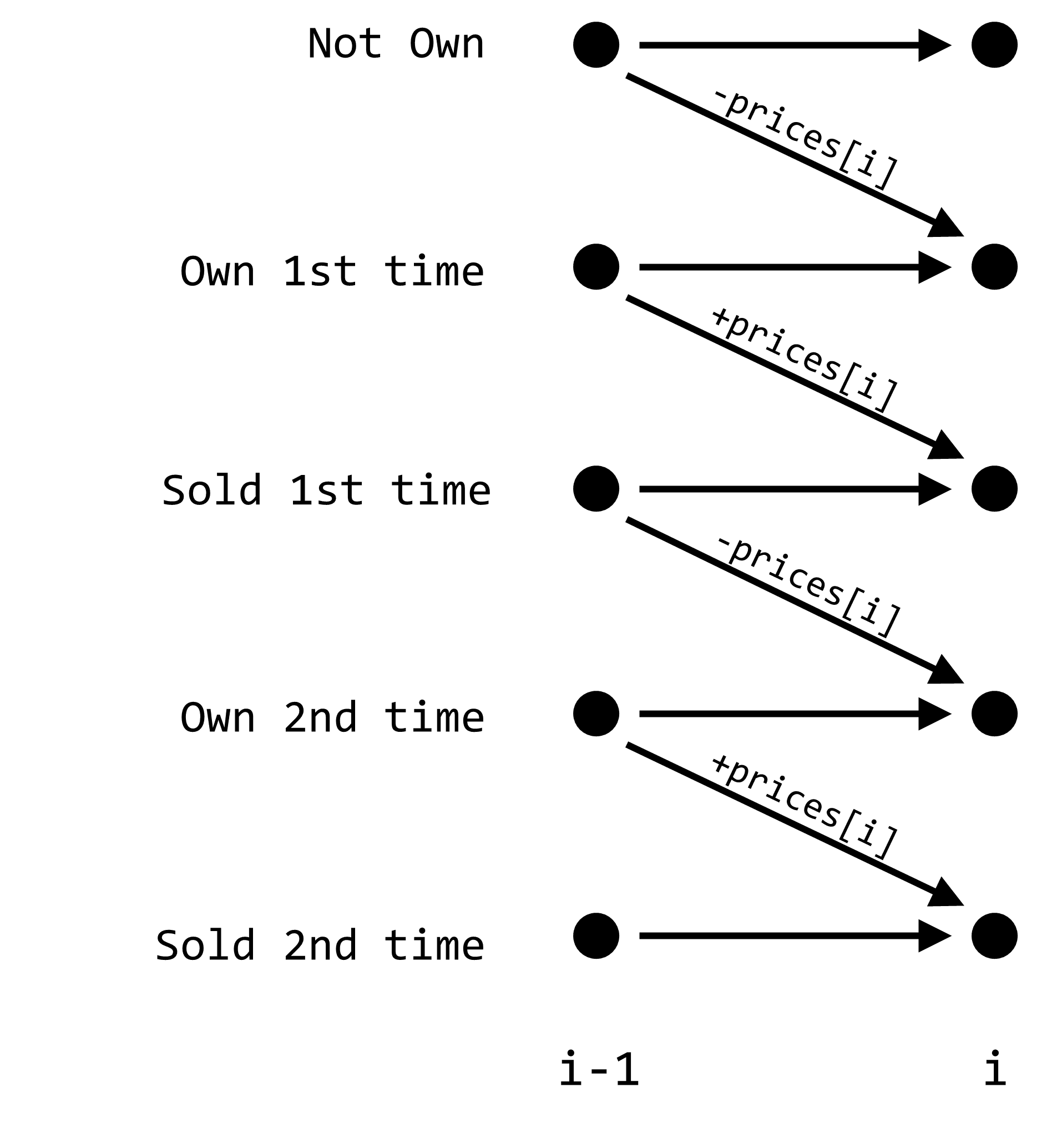
We're looking for the max profit in any of these states on the last day.
1. Recursion
To find a recursion for each state, you can look at all the arrows that point to it:
N(i) = N(i-1)                               # hold
O1(i) = max(O1(i-1), N(i-1) - prices[i])    # hold or buy
S1(i) = max(S1(i-1), O1(i-1) + prices[i])   # hold or sell
O2(i) = max(O2(i-1), S1(i-1) - prices[i])   # hold or buy
S2(i) = max(S2(i-1), O2(i-1) + prices[i])   # hold or sell
2. Base case
The recursion eventually gets to i=-1. This is when the recursion needs to stop, since there are no previous days' stock prices. We start not owning the stock and with 0 profit. We can't reach the other states yet on the first day, so we just set their profits to -infinity so they'll get overwritten when we finally can reach them.
N(-1) = 0
O1(-1) = float('-inf')
S1(-1) = float('-inf')
O2(-1) = float('-inf')
S2(-1) = float('-inf')
3. Code
Combining the recursion and base case, and using "Tabulation+", we get:
def twoshotProfit(prices):
    # day -1
    N = 0
    O1 = float('-inf') # -infinity
    S1 = float('-inf')
    O2 = float('-inf')
    S2 = float('-inf')

    # day 0, 1, ..., n-1
    for i in range(len(prices)):
        (N, O1, S1, O2,  S2) = (
            N,
            max(O1, N - prices[i]),
            max(S1, O1 + prices[i]),
            max(O2, S1 - prices[i]),
            max(S2, O2 + prices[i])
        )

    return max(N, O1, S1, O2, S2)
Time Complexity O(n). We loop though an array.
Space Complexity O(1). We store 5 variables.