
Recursion
Breadth First Traversal
Given the root node of a binary tree root, return an array containing the Breadth-First traversal of the tree.
Example:
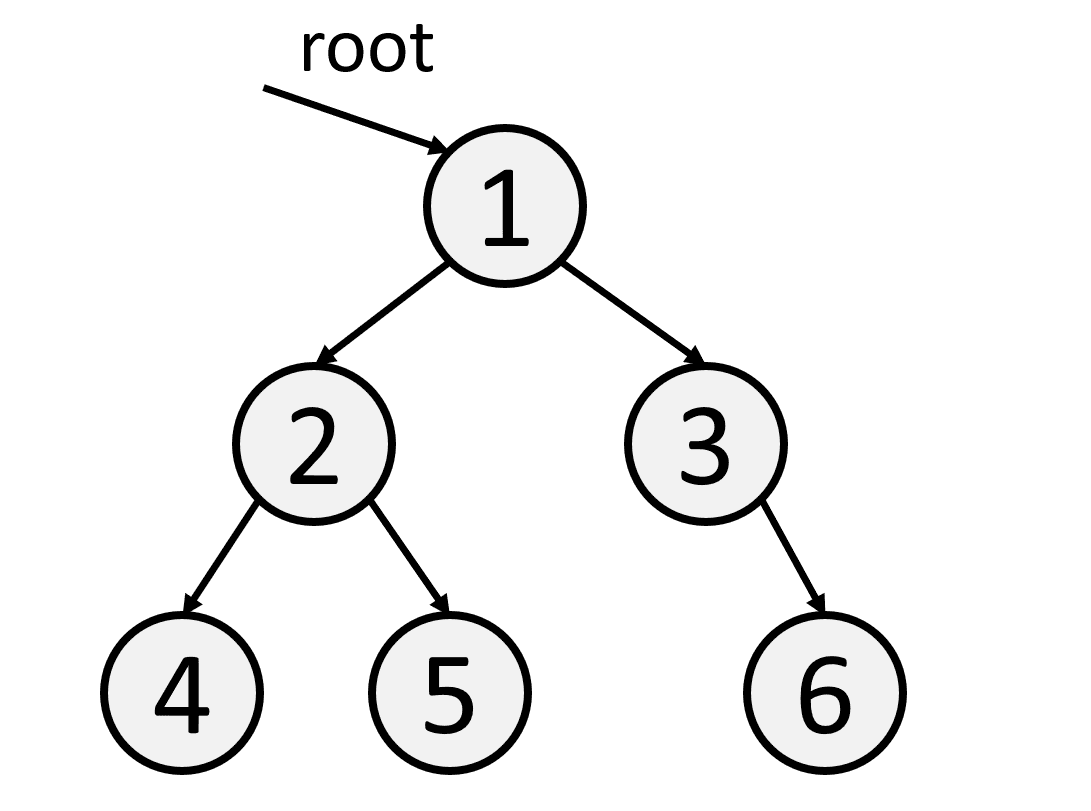
=> returns [[1], [2,3], [4,5,6]]
First Few Test Cases:
treeLayers(TreeNode.of([1, 2, 3, 4, 5, None, 6]))
# [[1], [2, 3], [4, 5, 6]]
treeLayers(TreeNode.of([1, 2, 3]))
# [[1], [2, 3]]treeLayers(TreeNode.of([1, 2, 3, 4, 5, 6, 7]))
# [[1], [2, 3], [4, 5, 6, 7]]Since this is a BFS problem, we can jump right into the code. Here's the code for a BFS that goes layer by layer, which you should memorize (see the previous lesson for a derivation):
queue = deque([root])
while queue:
    # loop through nodes in current layer
    for _ in range(len(queue)):
        node = queue.popleft()
        if node.left: queue.append(node.left)
        if node.right: queue.append(node.right)
Now let's modify this code to get the solution.
We want to add all the values in a layer to an array, which we'll call layer. We're done with a layer, we'll add it to our solution soln.
You can stick some lines of code into the above BFS to code this up:
from collections import deque

def treeLayers(root):
    soln = []
    queue = deque([root])
    while queue:
        layer = []                  # create layer
        for _ in range(len(queue)):
            node = queue.popleft()
            layer.append(node.val)  # add value to layer
            if node.left: queue.append(node.left)
            if node.right: queue.append(node.right)
        soln.append(layer)          # add layer to soln

    return soln
Time Complexity O(n). We look through every node in the tree.
Space Complexity O(n). We store an array with all the values.
Mark as Completed: